Platform Core
Technologies
Building autonomous quantitative AI research infrastructure for alpha discovery. Every algorithm is designed to improve the experimentations while keeping research reproducible, scalable and secure.
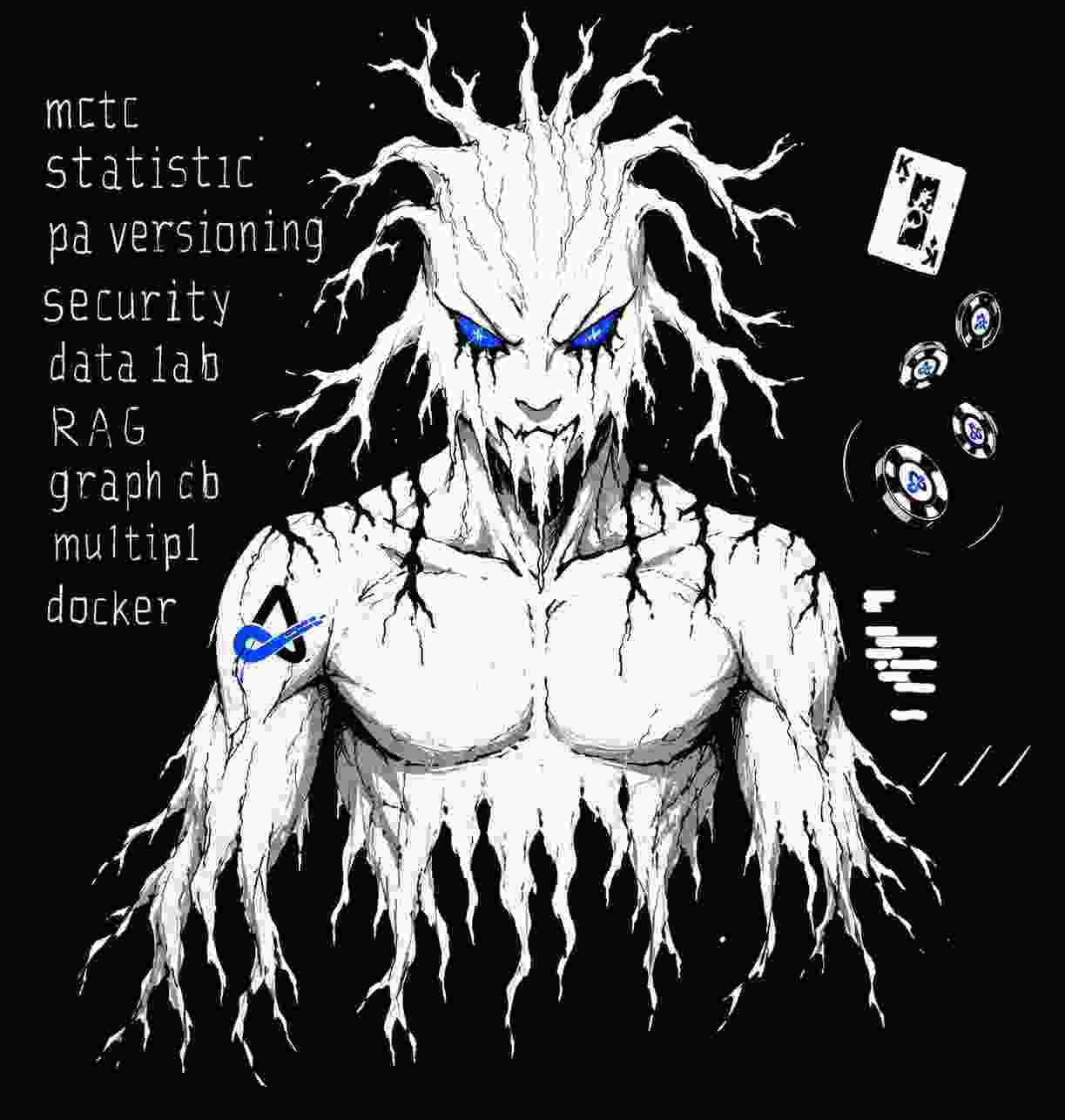
Monte Carlo Tree Search
Originally designed for efficient decision-making in robotics and game-playing systems, Monte Carlo Tree Search has been adapted to optimize the search for the best combination of prediction targets, portfolio configurations and training periods. Instead of randomly exploring an almost infinite number of possible combinations, MCTS intelligently prioritizes the most promising research directions.
Statistical Lab
An experimentation engine built specifically for running A/B tests without spending too much time on the design. The infrastructure allows experiments to run in parallel with the production research pipeline, making it easy to measure how changes such as model temperature, prompts or agent logic directly affect metrics like ROI.
Prompt & Agent Versioning
An advanced versioning system for prompts and agent source code that allows the research pipeline to evolve without losing historical experiments. Every modification can be tracked, compared and reproduced, making the system tightly integrated with Statistical Lab for large-scale A/B testing.
Security Architecture
Working trading algorithms should never become part of commercial AI model training, as this could significantly reduce or even eliminate their future profitability. For this reason, the infrastructure was designed to completely isolate sensitive research code from AI agents. The platform also supports fully local language models, allowing confidential research to remain entirely on-site.
Agentic Infrastructure
The interaction between AI agents is designed to enable continuous research without human intervention. Agents receive structured feedback from previous mistakes, allowing them to iteratively improve hypotheses, implementations and reasoning throughout the entire research pipeline. Additional validation agents detect hallucinations and trigger automatic correction before experiments continue.
Retrieval-Augmented Generation
Retrieval-Augmented Generation is used to detect duplicate research hypotheses before computational resources are spent evaluating them. By comparing new ideas against previous experiments, the system eliminates redundant research and focuses only on genuinely new opportunities.
Graph Database
A graph database stores relationships between every experiment, making it possible to quickly reconstruct complete research chains together with all associated metadata. The graph is synchronized with the primary experiment database, where every stage can also be traced using OpenTelemetry and Jaeger. Both databases are designed to provide complete experiment coverage and support complex A/B testing inside Statistical Lab.
Multiprocessing
Parallel execution and independent research agents are central to increasing the speed of alpha discovery. Multiple experiments run simultaneously while the total number of concurrent processes is strictly controlled through configurable experiment parameters.
Data Lab
Financial datasets, especially in high-frequency trading, rarely fit entirely into system memory. Data Lab is designed so that every stage of the data pipeline—including preprocessing, feature engineering and model training—operates without loading complete datasets into RAM, allowing research to scale naturally as datasets continue to grow.
Docker Infrastructure
Every major service within the research platform is isolated inside its own Docker container. This architecture simplifies development today while preparing the infrastructure for future horizontal scaling across multiple machines using orchestration platforms such as Kubernetes.