Playing Poker after taking Viagra. Analysing the effect from the math perspective
Introduction
If you watched a movie called Limitless or read a book called 'The Dark Fields' by Alan Glynn (Limitless is an adaptation), you probably contemplated the idea of taking a pill that would make you smarter. If you did not watch the movie or read the book, then I can describe it briefly: the main character is a loser (an underdog) who, after taking a pill, becomes extremely smart and changes his life significantly. Even though Viagra makes a different impact on men, there is still an interesting idea I want to test. And the book was just an inspiration. I want to understand whether conditions that people try to avoid, like fear, adrenaline, pain, unsatisfied sexual desire, etc., can actually be a way to channel our energy into better decision-making and improve cognitive performance.
Experiment Design
The experiment is going to be an AB test, where Group A (control) - is me playing without Viagra. Group B - me playing after taking Viagra.
Structure of the experiment:
- Poker room - 888 Poker (I have a high level there + there is a lot of fish excluding me)
- Game Type - Texas Holdem (Cash)
- Table Format - 6-max table
- Game Structure - I will be playing 3 tables at the same time
- Limits - Buy-in 5$ (I am not a millionaire and Viagra is fucking expensive)
- Session duration - from 6 pm till 10 pm
- Statistics - To gather statistics I used Holdem Manager 3
Mathematical Structure of the Experiment:
-
The main metric is win rate (big blinds / 100)
-
Null Hypothesis - H0: Viagra does not have any effect on poker skills and win rate. If you are not familiar with AB tests, usually we want to reject the null hypothesis (H0).
-
Expected Effect Size () - I suggested that there was a statistically significant effect on win rate after taking Viagra and estimated it +5 bb/100. It means I am planning to catch at least 5bb difference of the win rate. The less the effect that I want to catch, the more hands I will have to play (you will see that calculation in a formula below)
-
Typical standard deviation of winrate in 6-max NLHE: , I took
-
Required hands per group for an independent t-test with 80% power and :
where Z₁.₉₆ ≈ 1.96, Z₀.₈₄ ≈ 0.84.
So, I needed to play over 3k hands in each group, that would be over 6k hands total. And I considered it was time to learn more about Viagra - the dosage, side effects, durability, price, etc. Here is the list of the main things that I learned:
- The effect starts in about 30 minutes after taking a pill
- The effect lasts for about 4 hours (that was perfect for the time I considered to play - from 6 pm till 10 pm)
- You need sexual stimulation after taking Viagra in order to observe the effect. But what is 'the effect' in this case? Viagra pumps blood to your dick, which affects the way you make decisions (right?), focus duration, and your outlook on life (you observe the world a little bit differently with a hard on). There is a study that claims that an erection increases confidence. Well, in this study, they proved women find men with an erection more attractive, and being attractive for the opposite sex makes you more confident [1]. Eventually, I thought I would solve this 'stimulation problem'
- Based on the instructions I concluded that the dosage for me would be 50mg, that is in between recommended dosage 25mg and 100mg (when I said between, I did not mean (25 + 100) / 2, but just men take Viagra from this set S={25, 50, 100} and 50 is in between).
I also found interesting facts about Viagra while doing the research. Here are some of them with links:
- Viagra was born from a failed drug to treat angina. Men reported this unusual side effect. Imagine that (https://www.bbc.com/future/article/20130917-the-surprising-origins-of-viagra)
- The name is a combination of vigor (strength) and Niagara (Niagara Falls). Back in the days when there was no AI, people could do something creative (https://time.com/3986448/viagra-name-history/)
- Viagra can turn your vision blue (or make it blurry). This side effect was in every instruction I read. I did not have that side effect, though I read some responses where men claimed it was hard for them to focus because of that (https://www.mayoclinic.org/drugs-supplements/sildenafil-oral-route/description/drg-20066989)
So, it was time for me to calculate how many Viagra pills I will need. It was time to do some math again. I decided to play 3 tables for 4 hours. In 6-max NLHE, the number of hands you play per hour is about 90 (based on my statistics from HM3, I had 94 with unknown standard deviation; I did not want to overcomplicate anything). I concluded I would play 90 * 3 = 270 hands per hour. 4 hours of play would give me 4 * 270 = 1080 hands per day. So, that would take me 3 days of playing in each group, and 150mg of Viagra to finish the experiment.
The first problem was that the drug was not available. It was surprising considering how expensive that is, and the economy is in a recession. I did not buy anything online because I found an article that about 50% of the online Viagra sold is fake and dangerous. Was that the risk I was willing to take? And what do they mean "dangerous"? Pollution-dangerous? Sterility-dangerous? Death-dangerous? Not worth it. I decided to drive around the city and found in one pharmacy 2 packs of Viagra, 100mg in each. So, I had to buy both. In the end, I had 200mg of Viagra.
Playing under Viagra
Playing without Viagra was not anything special for me. The same ups and downs, the same players, the same default settings. I remember the times when it used to be so scary to bluff, and the insane amounts of adrenaline I got from bluffing. It is in our human nature to get used to everything that happens around us too often. For example, if you are perpetually exposed to heights, high-speed driving, or talking to girls, you get less and less rush every consecutive time. I noticed that I was still not very confident when I had to bluff. This was just something I had to do to play a balanced game.
The Viagra experience was, of course, diabolical. 30 minutes after I took it for the first time, I already felt my heart beating. And I could feel a pulse on my dick even without touching it. Honestly, the first hour was the most difficult to stay focused. I was thinking about too many things, like I thought I was going to die. But then I managed to channel my extensive energy into the game itself.
Do you remember I mentioned that Viagra requires sexual stimulation to work? It seems like it does not have to be sexual, because when I overcame the feeling that I would pass away with a hard-on and focused on the game, I noticed the difference. I wanted to make more risky decisions. Not risky in terms of just an intuition, but based on statistical factors. I was more aggressive with tight players, trying to find an optimal balance of getting as much as I could from that person by losing as little as possible. Of course, I also did it without Viagra, but I was still more conservative. It was like my mind was clear, like I was looking into the future with so much anticipation. Placebo? Maybe. Maybe the confidence thing. But not from the biological standpoint. Remember, I mentioned that an erect penis makes a man more attractive and increases confidence? You often need that confidence in poker.
Groups Analysis
Before doing the t-test, I had to make sure the groups happened to be balanced. In other words, I needed to know how many pairs I had in group A and group B, how many premium hands I had in group A and B, the share of hands by position in each group, what positions I played the most (though I was confident the positions would be balanced), etc.
Overall, I played 3247 hands in Group A (without Viagra), and 3338 hands in Group B (with Viagra). As you see:
We must mathematically prove that we can work with these group volumes. I would not like to incorporate other techniques to fix that. We will use test to test our null hypothesis:
H0: the number of hands in Group A == the number of hands in Group B
Here is the math formula:
but I will use the Python scipy library to calculate the p-value:
from scipy.stats import chisquare

counts = df["group"].value_counts()
expected = [len(df) / 2, len(df) / 2]
chi2, p_value = chisquare(counts.values, f_exp=expected)
I got p-value:
np.float64(0.26211439424422495)
Thankfully our . It means we do not reject our hypothesis, that states:
H0: the number of hands in Group A == the number of hands in Group B
Let us move to internal analysis.
Here are the results:
Overall Premium Table
| Group | Category | Hands | Percent |
|---|---|---|---|
| A | Medium | 66 | 2.03% |
| A | Premium | 42 | 1.29% |
| A | Strong | 26 | 0.80% |
| A | Weak | 3113 | 95.87% |
| B | Medium | 68 | 2.04% |
| B | Premium | 40 | 1.20% |
| B | Strong | 22 | 0.66% |
| B | Weak | 3208 | 96.11% |
Overall Category Percentages
| Group | Medium | Premium | Strong | Weak |
|---|---|---|---|---|
| A | 2.03% | 1.29% | 0.80% | 95.87% |
| B | 2.04% | 1.20% | 0.66% | 96.11% |
Hands per Group × Position
| Group | Position | Hands |
|---|---|---|
| A | BB | 542 |
| A | BTN | 541 |
| A | CO | 541 |
| A | HJ | 541 |
| A | SB | 541 |
| A | UTG | 541 |
| B | BB | 556 |
| B | BTN | 557 |
| B | CO | 556 |
| B | HJ | 556 |
| B | SB | 557 |
| B | UTG | 556 |
Category by Position (first 12 rows)
| Group | Position | Category | Count | Total | Percent |
|---|---|---|---|---|---|
| A | BB | Medium | 19 | 542 | 3.51% |
| A | BB | Premium | 6 | 542 | 1.11% |
| A | BB | Strong | 3 | 542 | 0.55% |
| A | BB | Weak | 514 | 542 | 94.83% |
| A | BTN | Medium | 6 | 541 | 1.11% |
| A | BTN | Premium | 7 | 541 | 1.29% |
| A | BTN | Strong | 3 | 541 | 0.55% |
| A | BTN | Weak | 525 | 541 | 97.04% |
| A | CO | Medium | 10 | 541 | 1.85% |
| A | CO | Premium | 9 | 541 | 1.66% |
| A | CO | Strong | 5 | 541 | 0.92% |
| A | CO | Weak | 517 | 541 | 95.56% |
Pivoted Table — Category Percentages by Group & Position
| Group | Position | Medium | Premium | Strong | Weak |
|---|---|---|---|---|---|
| A | BB | 3.51% | 1.11% | 0.55% | 94.83% |
| BTN | 1.11% | 1.29% | 0.55% | 97.04% | |
| CO | 1.85% | 1.66% | 0.92% | 95.56% | |
| HJ | 1.48% | 1.29% | 1.11% | 96.12% | |
| SB | 1.48% | 1.66% | 1.11% | 95.75% | |
| UTG | 2.77% | 0.74% | 0.55% | 95.93% | |
| B | BB | 1.98% | 1.26% | 0.54% | 96.22% |
| BTN | 2.33% | 1.44% | 0.90% | 95.33% | |
| CO | 2.52% | 1.08% | 1.08% | 95.32% | |
| HJ | 1.98% | 1.80% | 0.18% | 96.04% | |
| SB | 1.97% | 0.36% | 0.18% | 97.49% | |
| UTG | 1.44% | 1.26% | 1.08% | 96.22% |
And visualization:
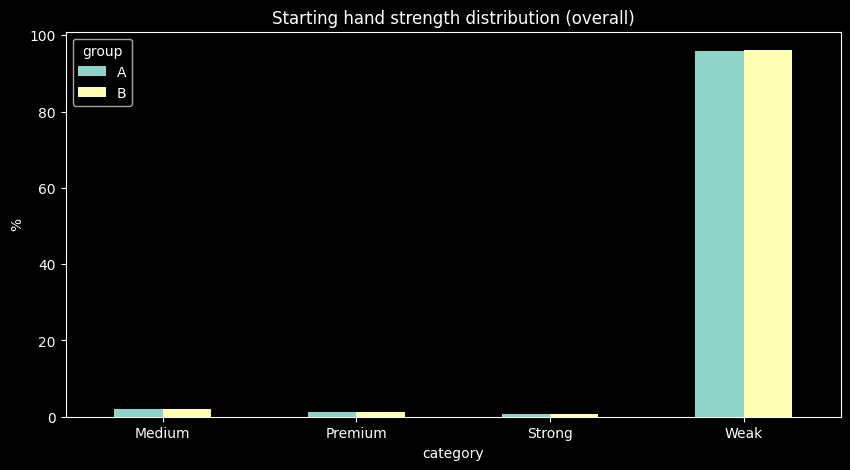
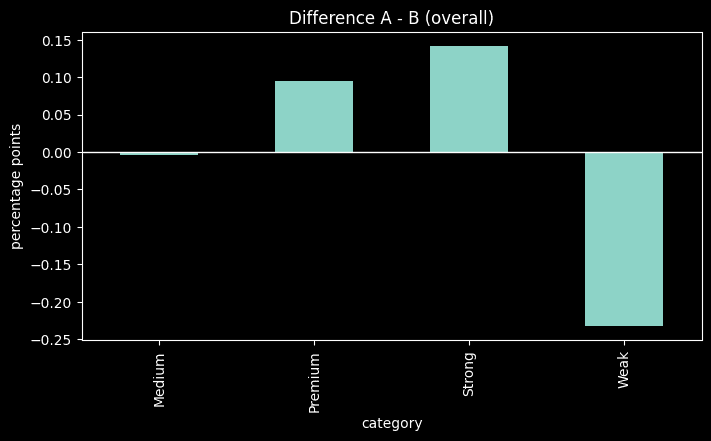
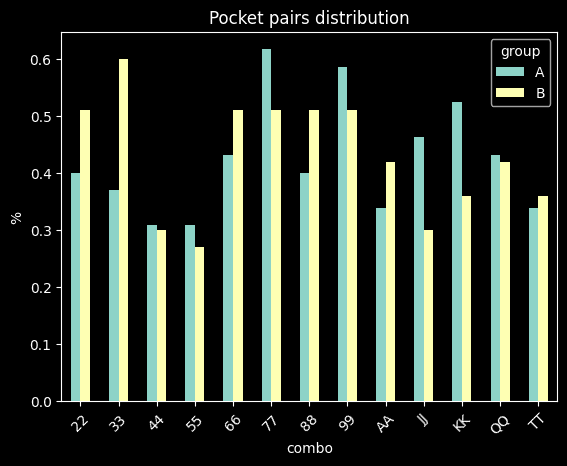
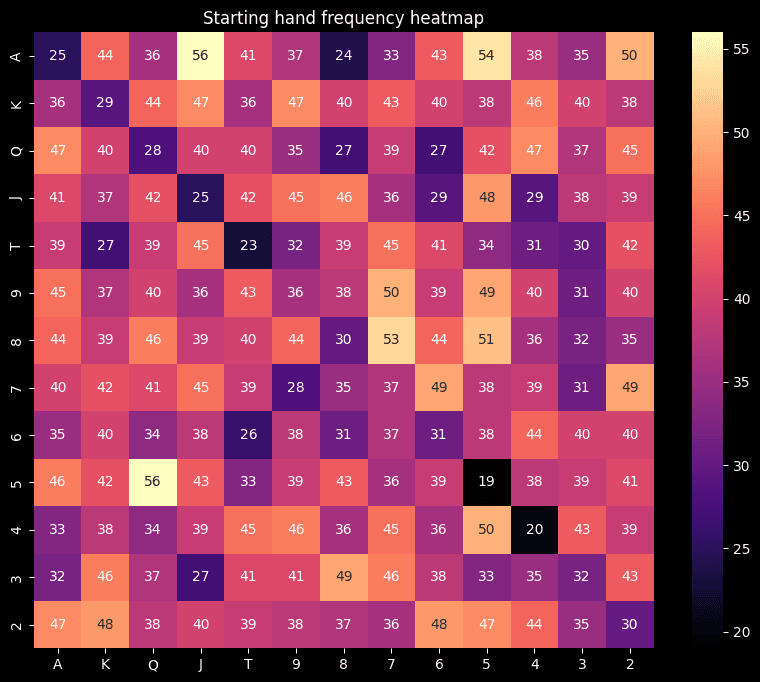
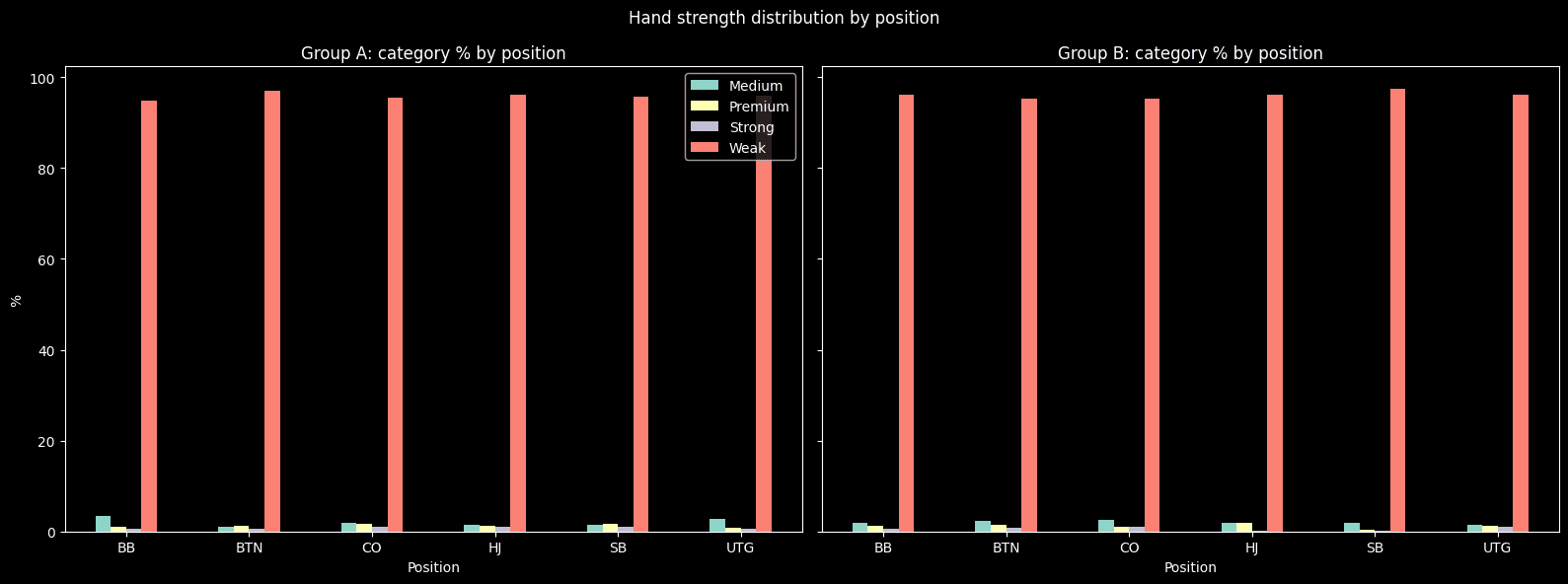
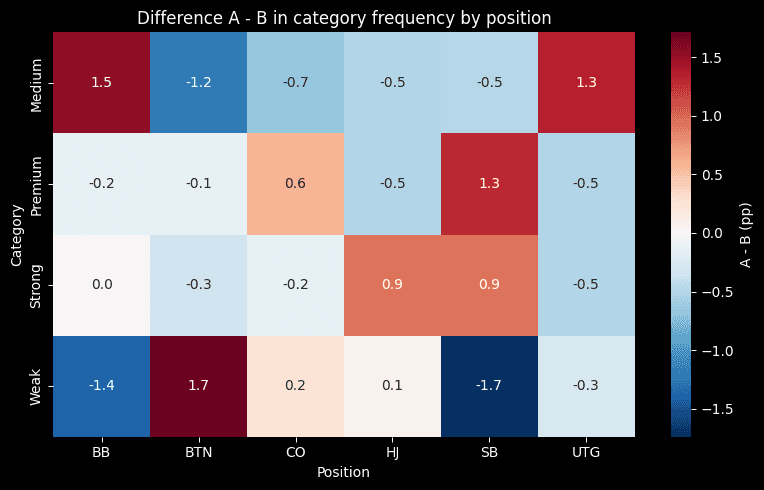
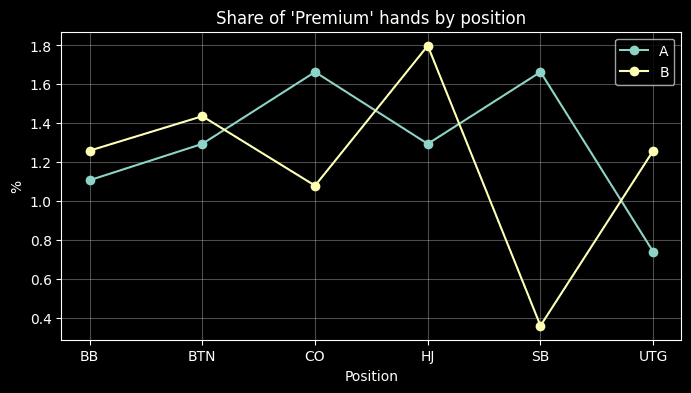
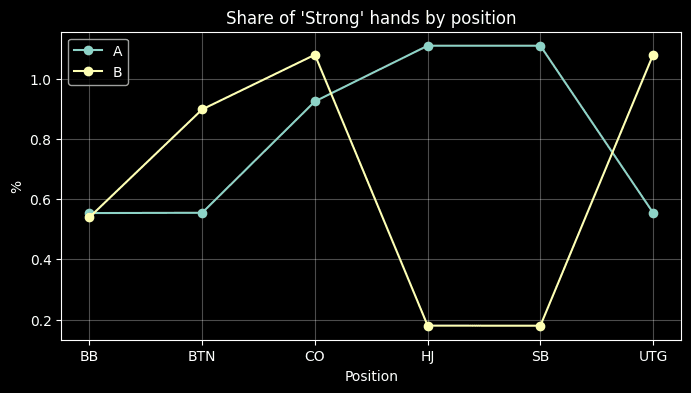
Even though some of the combinations, depending on how you group them, are significantly different, in order to get very accurate and balanced distribution you need to play about 100.000 hands. The more hands you play, the closer the results are to their true values. It is our fundamental Law of Large Numbers [2]. You probably understand what problems I would face trying to get to 100.000. Erectile dysfunction for life, maybe even death.
I did not perform an analysis of the games themselves because I initially expected the games to be different. Because of the Viagra effect. So, I did not statistically analyze how many flops or rivers I played in each group because an imporvement or deterioration of my strategy must be clear after performing an AB test. Preflop hands, though, can show whether I had an upstrick/downstrick in a certain group, which I did not.
Win Rate by Group
When I looked at my win rate, I was not very happy, not gonna lie. I set up the test to catch about 5 bb/100 difference, but we got:
Group A - 5.6 BB/100
Group B = 7.1 BB/100
It is only 1.5 bb/100 difference. In order to catch that type of difference and confidently say that Viagra improves your poker skills, I had to play about 28k hands in each damn group. But we must let the math do the talking here before concluding anything.
Based on the results, let us do the t-test:
import numpy as np
from scipy.stats import t

mean1 = 5.6     # bb/100
mean2 = 7.1     # bb/100
n1 = a / 100 # this is the number of blocks
n2 = b / 100

# Even though the number of hands is not that big I decided to calculate sigmas for each group
sigma1 = 86.4   # this is 86.4 bb/100 deviation, which is quite normal for NLHE
sigma2 = 91.3   # this is with Viagra

# calculating standard error
se = np.sqrt(sigma1**2 / n1 + sigma2**2 / n2)

# t-statistics
t_stat = (mean2 - mean1) / se

# degrees of freedom calculated by Welch–Satterthwaite equation
# I consider sigmas not to be equal, othervise we could calcualte it like 'n1 + n2 - 2'
# I decided not to do another test on sigmas
df_num = (sigma1**2 / n1 + sigma2**2 / n2)**2
df_den = (sigma1**4 / (n1**2 * (n1 - 1))) + (sigma2**4 / (n2**2 * (n2 - 1)))
df = df_num / df_den

p_value = 2 * (1 - t.cdf(abs(t_stat), df))

print(f"t-stat = {t_stat:.4f}")
print(f"df = {df:.2f}")
print(f"p-value = {p_value:.4f}")
t-stat = 0.0685
df = 63.80
p-value = 0.9456
So, the p-value is 0.9456. And , so we have to conclude that the result is not statistically significant (p-value=0.95). We cannot reject our null hypothesis, which was:
H0 = Viagra does not improve poker skills
BUT, because the observed effect was much smaller (1.5bb/100) than the expected 5bb/100, 3000 hands is too small a number to detect that small difference. I want you to understand that it does not mean Viagra does not improve poker skills (or decision-making); it means it might improve the skills, but probably by less than 5bb/100, which we were unable to detect. Or I am just coping.
Conclusion
Yes, I failed to prove such an important concept in science. But I swear I could feel the effects. The confidence boost and desire to make riskier (but calculated) decisions. I truly believe it increased my stress tolerance. I can still feel it. Which means the experiment was not a waste of my time and resources. I felt it expanded my comfort zone, which, in theory, must open more opportunities for me. The only thing left for me to do is to find them. And I still have 50mg of Viagra to seize at least one of those opportunities.